

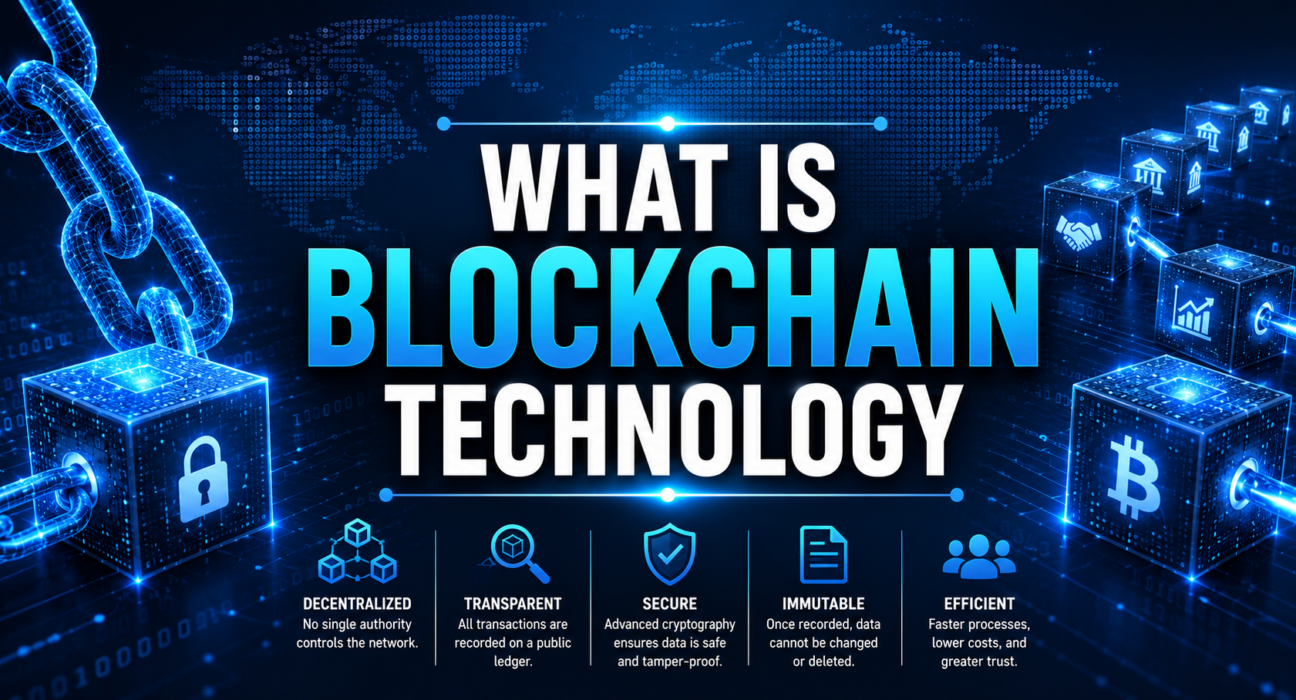
Blockchain technology is like a shared notebook that thousands of people keep a copy of. No one can secretly erase or change what’s written in it. It’s used for things like digital money, tracking packages, and storing health records.
Most people hear “blockchain” and think Bitcoin. That makes sense — but blockchain is bigger than that. Blockchain is the system that makes Bitcoin work. And today, it’s being used in hospitals, stores, voting booths, and shipping companies too.
This guide explains what blockchain technology is, how it works, the different types, why it’s useful, and where it’s being used right now. You don’t need to know anything about computers to understand this.
How Does Blockchain Technology Actually Work?
Think about a regular notebook that only one person owns. If that person tears out a page, the record is gone. Blockchain works differently — it’s like giving a copy of that notebook to thousands of people at the same time.
Here’s what happens when something gets recorded on a blockchain:
- Someone starts a transaction — like sending money or tracking a package.
- That action is sent to thousands of computers around the world, called nodes.
- Those computers check if the action is real and follows the rules. This is called a consensus mechanism — basically, everyone votes to agree.
- Once approved, the action is packed into a block with other actions.
- That block is added to a long line of older blocks — like adding a new page to a notebook.
- Now everyone’s copy shows the new record, and no one can change it secretly.
That’s the key part. If someone tries to change one block, they’d have to change every block after it on every single computer at the same time. That’s nearly impossible to do.
Each block holds three things:
- Transaction data — what actually happened (e.g., “Alex sent $10 to Sam”)
- A timestamp — the exact time it was recorded
- A hash — a special code, like a fingerprint, that connects it to the block before it
If you change anything in a block, its fingerprint changes. That breaks the chain, and every computer in the network notices right away.
What Are the Main Benefits of Blockchain Technology?
Blockchain fixes problems that normal systems struggle with. Here’s what makes it special:
Does blockchain technology actually prevent fraud?
Yes. To commit fraud, you usually need to change old records. On a blockchain, once something is recorded, it stays there forever. No one person can delete or edit it. Every computer in the network would have to agree to the change — and the majority will always say no to fake changes.
Is blockchain data truly transparent?
On public blockchains, anyone can see the records. That’s useful when people need to check that money was spent correctly, or that a product came from where it says it did. Private blockchains only show records to people who are allowed to see them.
Key benefits, in plain terms:
- No single boss — no one person or company controls the whole thing
- Can’t be changed — old records stay exactly as they were
- Open to check — anyone (or approved people) can verify the history
- Very hard to hack — changing one record would break the whole chain
- Saves time — some tasks that used to need lawyers or banks can happen automatically
What Are the Different Types of Blockchain?
Not all blockchains work the same way. Here are the four main types:
Public Blockchain
Anyone can join and see the records. Bitcoin and Ethereum are public blockchains. The downside is that they can be slow, because thousands of computers all need to agree on every action.
Private Blockchain
Only certain people are allowed in. One company controls who can join and who can add records. It’s faster, but fewer people are involved — so it’s more centralized.
Consortium Blockchain
A group of companies share control. Imagine five banks running one shared blockchain together. It’s more open than a private blockchain but more controlled than a public one.
Hybrid Blockchain
A mix of both public and private. Some information is open for everyone to see. Other parts are kept private. Companies use this when they want some things to be public but need to keep other things confidential.
Where Is Blockchain Technology Being Used Today?
Blockchain isn’t just an idea anymore. Here’s where it’s being used right now:
Cryptocurrency and Sending Money
Bitcoin uses a blockchain to keep track of who sent money to whom, without needing a bank in the middle. Sending money to another country can now happen in minutes instead of days.
Tracking Products
Big companies like Walmart use blockchain to track food and products from the farm or factory all the way to the store shelf. If something goes wrong — like spoiled food — they can find the source in seconds instead of days.
Health Records
Doctors can store your health records on a blockchain. Only the right doctors can see them. You stay in control of your own records, and every time someone accesses them, it’s logged permanently.
Smart Contracts
A smart contract is like a vending machine. You put money in, press a button, and the machine gives you a snack — no person needed. Smart contracts work the same way on a blockchain: when certain conditions are met, the action happens automatically. No middleman needed.
Voting
Some countries are testing blockchain voting where every vote is recorded safely and can be checked later. No one can change a vote after it’s been cast.
Is Blockchain Technology Right for Every Use Case?
No — and most guides don’t say that clearly enough.
Blockchain is a good fit when:
- Different groups need to share data but don’t fully trust each other
- You need a permanent record that can’t be changed
- Removing a middleman (like a bank) saves time or money
A regular database works better when:
- One company controls all the data
- You need things to happen very fast
- The data changes often and you don’t need a permanent history
Blockchain sounds like the answer to everything until you realize that many problems just need a simple, well-organized database. Ask yourself first: does this problem actually need decentralization? If the answer is no, a regular database will do the job faster and cheaper.
What’s Next After Learning the Basics of Blockchain?
Blockchain is not one single app or website. It’s a way of storing and sharing information that no one person controls. Once you get that idea, other things like Bitcoin, NFTs, and Web3 become much easier to understand.
If you want to keep learning, look into how Ethereum lets people build apps on top of a blockchain, or how groups of companies use blockchains like Hyperledger Fabric to share data safely. Everything you learned here applies to all of those.
Frequently Asked Questions About Blockchain Technology
What is blockchain technology in simple terms?
Blockchain is like a shared notebook. Thousands of computers each hold a copy. When something new is written in it, everyone’s copy updates at the same time. No one can secretly erase or change what’s already there.
How is blockchain different from a regular database?
A normal database is like a notebook owned by one person or company — they can change it anytime. A blockchain is shared across thousands of computers, and changing an old record would require approval from most of them. That makes it much harder to tamper with.
Do I need to understand cryptocurrency to understand blockchain?
No. Cryptocurrency is just one thing built on top of blockchain. The blockchain itself is just a system for recording and storing information safely. You can understand it completely without knowing anything about Bitcoin.
Is blockchain technology secure?
Blockchain is very hard to tamper with because each record is connected to the one before it using a unique code. Changing one record breaks the whole chain, and the network notices immediately. That said, apps built on top of blockchains can still have bugs that hackers exploit.
What industries use blockchain technology the most?
Banking, supply chains, healthcare, real estate, and government services use it the most right now. More industries are exploring it as the technology becomes easier to use.
Is blockchain technology the same as Bitcoin?
No. Bitcoin is a digital currency that runs on a blockchain. The blockchain is just the system that keeps track of all Bitcoin transactions. Think of blockchain as the road and Bitcoin as one of the cars driving on it.