


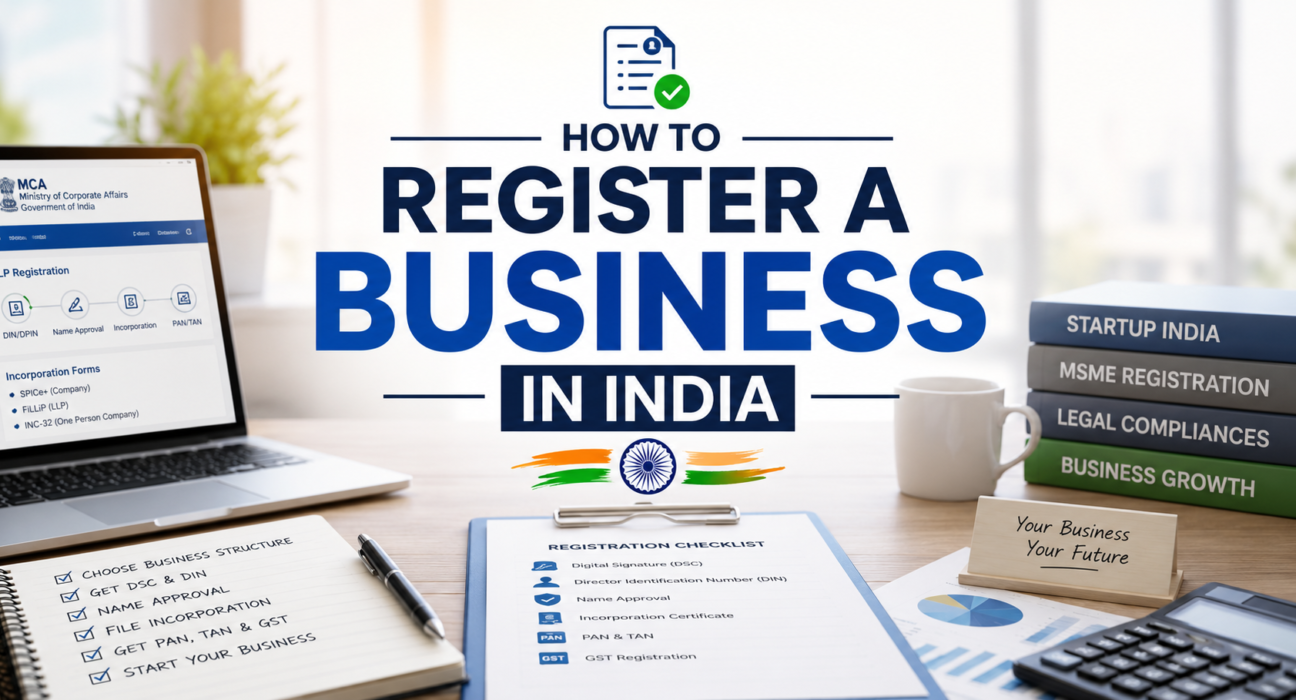
Starting a business in India is one of the most exciting steps you can take as an entrepreneur. But between the excitement of building your idea and the reality of getting it off the ground, there’s an important step that many founders underestimate — business registration in India.
Getting your business registration right from the start affects everything: your taxes, your legal protection, your ability to raise capital, and your long-term credibility. Skip it or do it wrong, and you could be dealing with compliance headaches, rejected bank applications, or legal exposure down the line.
This complete 2026 guide to business registration in India walks you through every step — from choosing the right business structure to completing your company registration process and obtaining the right business licenses. Whether you’re a solo founder, a team of two, or a growing startup, this guide covers exactly what you need to know.
Why Register a Business in India?
Before diving into the how, it’s worth understanding the why. A lot of early-stage founders put off registering their business, thinking they’ll sort it out “once things pick up.” That’s a costly mistake.
Here’s what business registration in India actually gives you:
- Legal Identity: Once registered, your business becomes a separate legal entity. It can own property, sign contracts, open bank accounts, and even appear in court — all independently of you as an individual.
- Personal Asset Protection: If your business runs into debt or legal trouble, your personal savings, property, and assets are protected under structures like a Private Limited Company or LLP.
- Access to Funding: Banks, investors, and government schemes simply won’t engage with unregistered businesses. A registered company opens the door to loans, angel funding, and venture capital.
- Business Bank Account: Only registered businesses can open a proper corporate bank account — an essential step for separating your personal and business finances. Understanding What is Banking and how it applies to your business entity can help you make smarter financial decisions early on.
- Credibility: Clients, suppliers, and partners take you more seriously when you operate as a legally registered business. It signals stability and professionalism.
- Continuity: A registered business entity continues to exist even if the ownership changes, making it easier to grow, bring in partners, or eventually exit.
Types of Business Structures in India
One of the most important decisions in the company registration process is choosing the right business structure. Each type comes with different rules on liability, taxation, compliance, and investment eligibility. Here’s a breakdown of the most common options.
Private Limited Company
The Private Limited Company is the most popular structure for startups and growing businesses in India. It offers limited liability, a separate legal identity, and makes it significantly easier to raise capital from investors.
Key requirements:
- Minimum of 2 directors and 2 shareholders (maximum 200 members)
- At least 1 Indian resident director
- No minimum paid-up capital requirement
- Registered under the Companies Act, 2013
It’s the preferred choice for founders who want to attract angel investors or venture capitalists, issue ESOPs, and scale quickly. The main trade-off is a slightly higher compliance burden compared to other structures.
LLP (Limited Liability Partnership)
An LLP Registration combines the flexibility of a partnership with the liability protection of a company. Each partner is only responsible for their own actions — not those of other partners — which makes it ideal for professionals and service-based agencies.
Key requirements:
- Minimum of 2 designated partners
- At least 1 Indian resident partner
- No minimum capital requirement
- Annual compliance costs approximately 40% lower than a Private Limited Company
LLPs are popular among law firms, consultancies, design agencies, and other professional practices. They cannot, however, raise equity funding — so if you plan to bring in investors, a Private Limited Company is a better fit.
Sole Proprietorship Registration
The Sole Proprietorship is the simplest form of business in India. There is no separate legal entity — the owner and the business are the same. It’s easy to set up, has minimal compliance, and is completely owned and operated by one person.
Unlike a Private Limited Company or LLP, a Sole Proprietorship is not registered under the Companies Act, 2013. Instead, it’s recognized through registrations such as:
- MSME (Udyam) Registration
- GST Registration
- Shop and Establishment Act Registration
- Professional Tax Registration (where applicable)
The major downside is the absence of limited liability protection. If your business incurs debts, your personal assets are at risk. This structure works best for freelancers, small retailers, and very early-stage solo businesses with low risk.
MSME Registration
MSME Registration (officially called Udyam Registration) is available to Micro, Small, and Medium Enterprises across manufacturing, services, wholesale, and retail sectors. It is not a business structure in itself — rather, it’s an additional registration layer that unlocks significant government benefits.
Following the Budget 2025 revision (effective April 1, 2025), the MSME classification limits were updated:
| Category | Investment Limit | Turnover Limit |
|---|---|---|
| Micro | Up to ₹2.5 crore | Up to ₹10 crore |
| Small | Up to ₹25 crore | Up to ₹100 crore |
| Medium | Up to ₹125 crore | Up to ₹500 crore |
Key benefits of MSME Registration:
- Low-interest business loans and easier credit access
- Access to government tenders and the GeM marketplace
- Reduced cost for patent and ISO certifications
- Various government subsidies and schemes
- MAT credit carry-forward extended to 15 years (vs. 10 years for others)
The MSME registration process is entirely online through the Udyam Registration Portal (udyamregistration.gov.in) and — importantly — is completely free. No registration fees are charged by the government.
How to register for MSME online:
- Visit udyamregistration.gov.in
- Click “For New Entrepreneurs who are not Registered yet as MSME”
- Enter your Aadhaar number and entrepreneur’s name
- Validate via OTP and verify PAN
- Fill in personal and enterprise details, including investment and turnover figures
- Submit and receive your Udyam Registration Certificate by email
The certificate contains a unique 19-digit MSME registration number and has no expiry date as long as the entity remains compliant.
Company Registration Process (Step-by-Step)
For those incorporating a Private Limited Company or LLP, the company registration process in India runs through the Ministry of Corporate Affairs (MCA) portal. Here is the full step-by-step breakdown.
Total expected timeline: 7–10 working days
Step 1 – Obtain a Digital Signature Certificate (DSC)
Every director must obtain a Class 3 Digital Signature Certificate (DSC). This is used to sign all electronic forms submitted to the MCA. DSCs typically cost between ₹1,600 and ₹3,000 for two directors and can be obtained online.
Step 2 – Apply for a Director Identification Number (DIN)
Every director requires a unique Director Identification Number (DIN) issued by the MCA. The good news: up to 3 directors can obtain their DIN simultaneously during the incorporation process through the SPICe+ form, at no additional cost.
Step 3 – Reserve Your Company Name
Company name registration is a critical step. Your chosen name must be unique, not similar to any existing company or trademark, and must comply with MCA naming guidelines. You can check name availability and apply for reservation via the RUN (Reserve Unique Name) service on the MCA21 portal. Name reservation costs approximately ₹1,000.
Step 4 – Draft the MOA and AOA
Two core legal documents are required:
- Memorandum of Association (MOA): Outlines the purpose and powers of the company
- Articles of Association (AOA): Governs internal management, director behavior, shareholder rights, and profit distribution
These documents form the constitutional backbone of your company and must be drafted carefully.
Step 5 – File the SPICe+ Form with MCA
The SPICe+ (Simplified Proforma for Incorporating a Company Electronically Plus) is India’s consolidated online business registration form. It bundles the following in a single submission:
- Company incorporation
- PAN and TAN application
- EPFO, ESIC, and GSTIN registration
- Professional Tax registration (select states)
This integration has made online business registration in India significantly faster and more accessible than it was even five years ago.
Step 6 – Receive Your Certificate of Incorporation
Once the MCA validates all documents, the Registrar of Companies (ROC) issues the Certificate of Incorporation — the official birth certificate of your company. It includes your Corporate Identification Number (CIN), PAN, and TAN. From this point, your business legally exists and can operate, open bank accounts, and enter into contracts.
Online Business Registration Guide
All company registrations in India are now processed 100% online through the MCA21 portal (mca.gov.in). There is no need to visit government offices in person for a standard Private Limited Company or LLP registration. Here’s what the online process typically involves:
- Create an MCA account at the MCA21 portal
- Complete and submit the SPICe+ form with all required attachments
- Pay stamp duty (amount varies by state — more on this below)
- Track your application status in real time on the portal
- Download your Certificate of Incorporation digitally once approved
You can also check the status of any registered company on the MCA portal by navigating to MCA Services → View Company/LLP Master Data and entering the company name or CIN. Understanding What Is Business Finance and how it relates to your company structure will help you make more informed decisions throughout this process.
Also, Read This Blog: How to Start a Business with Low Investment in 2026
Documents Required for Business Registration
Submitting incorrect or mismatched documents is one of the most common reasons for registration delays. Here is the complete checklist for a Private Limited Company or LLP registration:
| Document Type | Required From | Notes |
|---|---|---|
| PAN Card | All directors & shareholders | Mandatory for Indian nationals |
| Passport | Foreign nationals | Mandatory; must be notarized/apostilled |
| Aadhaar Card / Voter ID / Driving Licence | All directors & shareholders | Any one accepted as address proof |
| Bank Statement or Utility Bill | All directors & shareholders | Not older than 2 months |
| Passport-size Photograph | All directors & shareholders | Recent, JPG format preferred |
| Electricity / Telephone Bill | Registered office | Not older than 2 months |
| NOC from Property Owner | Registered office | Required if rented or family-owned |
| Rent Agreement | Registered office | Required if office is rented |
| MOA & AOA | — | Drafted as part of the process |
For MSME Registration, the documentation requirements are minimal — just your Aadhaar number and PAN number. The Udyam portal automatically fetches PAN and GST-linked details from government databases.
For Startup India Registration, the required documents include:
- Certificate of Incorporation / MoA & AoA / Partnership Deed
- PAN card of the organization and authorized person
- Aadhaar card of the authorized person
- Business address proof
- Company bank statement
- Photographs of directors
- Website / social media link or pitch deck
Costs & Fees Involved
Company registration fees in India vary depending on your business structure, number of directors, authorized capital, and the state where your registered office is located. For most startups and small businesses, the total cost of registering a company in India falls between ₹7,000 and ₹30,000.
Cost Breakdown (Private Limited Company)
| Cost Component | Approximate Range |
|---|---|
| Name Reservation (RUN) | ₹1,000 |
| SPICe+ Filing Fee (₹1L capital) | ₹1,500 |
| Digital Signature – 2 directors | ₹1,600 – ₹3,000 |
| DIN – 2 directors | ₹1,000 |
| Stamp Duty (varies by state) | ₹200 – ₹10,000 |
| Professional Service Fees | ₹3,500 – ₹15,000 |
| Total Estimated Cost | ₹7,000 – ₹30,000 |
State-Wise Stamp Duty Comparison
One of the biggest variables in registration cost is stamp duty, which is levied on your MOA and AOA and differs significantly across states:
| State | Stamp Duty |
|---|---|
| Haryana | ₹120 |
| Delhi | ₹350 |
| Tamil Nadu | ₹700 |
| Maharashtra | ₹1,200 |
| Rajasthan | ₹5,500 |
| Karnataka | ₹10,000 |
Founders operating in high stamp duty states like Karnataka or Rajasthan may want to factor this into their planning. Choosing Delhi or Haryana as your registered office state can meaningfully reduce your initial registration cost.
Post-Registration Annual Compliance Costs
Getting registered is just the beginning. Every company must also budget for annual compliance costs:
| Compliance Item | Estimated Cost |
|---|---|
| ROC Filings | ₹5,000 – ₹8,000 |
| Statutory Audit | ₹10,000 – ₹25,000 |
| Income Tax Return Filing | ₹3,000 – ₹8,000 |
| GST Return Filing | ₹6,000 – ₹15,000 |
MSME Registration is free. There are no government fees for registering on the Udyam portal. Similarly, Startup India Registration through the official government portal carries no government fee — though third-party assistance services will charge a professional fee.
Learning about What Is Financial Investment can give you a broader perspective on how to allocate your startup capital wisely — balancing one-time registration costs against ongoing compliance and growth investments.
Legal Requirements for Business in India
Legal requirements for business in India go beyond just registering your entity. Once your company is incorporated, there are several additional obligations to fulfill:
GST Registration
Goods and Services Tax (GST) registration is mandatory if your business turnover exceeds:
- ₹40 lakhs for businesses dealing in goods
- ₹20 lakhs for service-based businesses
GST registration is free on the government portal. Businesses below these thresholds can voluntarily register to claim input tax credits and improve their supplier credibility.
PAN and TAN
Your company will automatically receive a Permanent Account Number (PAN) and a Tax Deduction and Collection Account Number (TAN) as part of the SPICe+ incorporation process. These are mandatory for filing income tax returns and deducting TDS (Tax Deducted at Source).
EPFO and ESIC Registration
Businesses with 10 or more employees must register with the Employees’ Provident Fund Organisation (EPFO) and the Employees’ State Insurance Corporation (ESIC). Both are covered under the SPICe+ form for new companies.
Annual ROC Filings
Every registered company must file annual returns and financial statements with the Registrar of Companies (ROC). Missing these deadlines results in penalties. Key filings include:
- AOC-4: Financial Statements
- MGT-7: Annual Return
- ADT-1: Auditor Appointment
Non-compliance can result in the disqualification of directors and eventually the striking off of the company. Understanding 10 SIP Secrets Every Investor and other financial strategies can help you manage these recurring costs more effectively as your business grows.
Startup India Registration Process
If your business qualifies as a startup, registering under the Startup India initiative can unlock significant government benefits — from tax exemptions to expedited patent approvals and access to government funding schemes.
Launched on January 16, 2016, and managed by the Department for Promotion of Industry and Internal Trade (DPIIT), the Startup India scheme has recognized over 242,000 startups to date.
Eligibility Criteria for Startup India Registration 2026
Your business must meet the following conditions:
- Incorporated as a Private Limited Company, LLP, or Registered Partnership Firm
- Not older than 10 years from the date of incorporation (20 years for deeptech recognized startups)
- Annual turnover should not exceed ₹200 crore in any financial year (₹300 crore for deeptech)
- Must not have been formed by splitting or reconstructing an existing business
- Must demonstrate innovation, scalability, or significant potential for employment or wealth creation
Sole Proprietorships are not eligible for Startup India recognition.
Step-by-Step Startup India Registration Process
Step 1 – Incorporate Your Business
First, ensure your business is legally incorporated as a Private Limited Company, LLP, or Registered Partnership Firm.
Step 2 – Register on the Startup India Portal
Visit startupindia.gov.in and create a startup profile by entering your business name, industry, location, and team details.
Step 3 – Submit the DPIIT Recognition Application
Access the “Get Recognised” section and complete the DPIIT application, which requires:
- A description of your product/service and its innovation
- Information on business scalability and potential for job creation
- Uploaded documents including your pitch deck, incorporation certificate, and director KYC
Step 4 – DPIIT Review
DPIIT officials review your application for eligibility and innovation. Applications lacking a clear value proposition or with incomplete documents may be returned for revision.
Step 5 – Receive Your Recognition Certificate
Upon approval, you receive the Startup India Certificate of Recognition digitally. This certificate enables you to apply for tax exemptions, government funding, and simplified compliance.
Typical approval time: 7–15 working days
Key Benefits of Startup India Recognition
- Income Tax Exemption under Section 80IAC for 3 consecutive financial years out of the first 10 years
- Angel Tax Exemption on investments received
- 80% rebate on patent filing fees, with government covering facilitator costs
- Self-certification of compliance under 6 Labour Laws and 3 Environmental Laws for 5 years
- EMD Exemption on government tenders
- Access to ₹10,000 crore Fund of Funds through SIDBI
- Fast-track winding up within 90 days under the Insolvency and Bankruptcy Code, 2016
Business License in India – What You Need
Beyond company registration, most businesses in India require one or more business licenses depending on their industry, location, and scale of operations. Here’s a summary of the most common ones:
Trade License
Issued by your local municipal authority, a Trade License (also known as a Shop and Establishment License) is required by most businesses that operate from a physical premises. It regulates your working conditions, hours, and nature of business activity. Requirements vary by state.
FSSAI License
If your business involves manufacturing, processing, storing, distributing, or selling food, you need a Food Safety and Standards Authority of India (FSSAI) license. This applies to restaurants, food startups, cloud kitchens, and packaged food producers.
Import Export Code (IEC)
Any business that wants to import or export goods or services must obtain an Import Export Code from the Directorate General of Foreign Trade (DGFT). It’s a one-time registration with no renewal requirement.
Professional Tax Registration
Applicable in states like Maharashtra, Karnataka, Tamil Nadu, and others, Professional Tax is levied on individuals and businesses engaged in professions, trades, or employment. Registration is mandatory if you have salaried employees in these states.
Sector-Specific Licenses
Depending on your industry, additional licenses may apply:
- SEBI Registration for financial services firms
- RBI License for NBFCs (Non-Banking Financial Companies)
- Pharmacy License for pharmaceutical businesses
- Drug License for the manufacture or sale of drugs
- Factories Act License for manufacturing operations
Conclusion
Business registration in India is not just a bureaucratic formality — it’s the foundation your entire business is built on. The right business structure determines your tax liability, your ability to raise capital, and your personal legal exposure. The right registrations (whether that’s an MSME Udyam certificate or a Startup India DPIIT recognition) unlock government schemes, funding, and credibility that can meaningfully accelerate your growth.
Here’s a quick recap of what to prioritize as you get started with how to register a business in India:
- Choose the right structure — Private Limited Company for funding-focused startups, LLP for professionals, Sole Proprietorship for solo low-risk ventures
- Complete your company registration through the MCA SPICe+ portal (7–10 working days)
- Gather your documents early to avoid delays
- Budget accurately — total costs typically range from ₹7,000 to ₹30,000 depending on state and structure
- Register for MSME if you qualify — it’s free and unlocks significant benefits
- Apply for Startup India recognition if you meet the eligibility criteria
- Obtain the required business licenses for your specific industry and location
If you’re feeling overwhelmed by the process, that’s completely normal. Many founders choose to work with a compliance professional or registration service to ensure everything is filed correctly the first time. The cost is usually well worth avoiding delays, rejections, or post-incorporation compliance issues.
The sooner your business is legally registered, the sooner you can open your business bank account, approach investors, sign contracts with confidence, and start building something that lasts.